8 Best European OpenAI Alternatives in 2026
The best European alternative to OpenAI in 2026 is Mistral AI, based in France. All 8 options below are European-owned, GDPR-native and ranked by feature parity and relevance.
By the EU Alternatives team Last updated
Our top pick this year is Mistral AI, but every option on this list is European-owned, GDPR-native, and production-ready. Worth a closer look: LightOn, Heabsy, Aleph Alpha, AIMLAPI.
OpenAI alternatives are mainly AI & Machine Learning and AI Assistants & Chatbots. Browse any of those categories for a wider shortlist beyond this list.
Top European OpenAI alternatives compared
| # | Alternative | Country | Open source | Free tier | Compare |
|---|---|---|---|---|---|
| 1 | Mistral AI | France | Yes | Yes | vs OpenAI → |
| 2 | LightOn | France | No | Yes | vs OpenAI → |
| 3 | Heabsy | Slovakia | No | No | vs OpenAI → |
| 4 | Aleph Alpha | Germany | No | No | vs OpenAI → |
| 5 | AIMLAPI | Estonia | No | No | — |
-
Frontier open-weight LLMs with APIs, chat assistant, code models, and sovereign on-premise deployments. Performance without leaving Europe.
Mistral AI is Europe's foremost foundation-model lab, shipping frontier open-weight LLMs and a full AI stack that spans consumer chat, developer APIs, and sovereign enterprise deployments. Founded in Paris, it powers assistants, coding agents, document analysis, and custom fine-tuned models for organizations that need state-of-the-art performance without sending their data to US hyperscalers.
The platform covers every layer: Le Chat as a consumer assistant with web search, image generation, and code execution; La Plateforme and Studio as the developer APIs and app-building tools; Forge for private fine-tuning; Mistral Compute for on-premise GPU infrastructure; and specialized models like Codestral for code completion, Devstral for agentic coding, and Voxtral for speech, all runnable on cloud, on-premise, at the edge, or on-device.
Key benefits:
- Open-weight models under permissive licenses that you can self-host, fine-tune, and audit
- Multimodal and multilingual coverage across text, code, documents, audio, and vision
- Le Chat assistant with native web search, image generation, document analysis, and code execution
- Codestral and Devstral specialized code models competitive with proprietary US alternatives
- La Plateforme API with transparent pay-as-you-go pricing and EU data residency by default
- On-premise and air-gapped deployments for regulated sectors like defence, banking, and healthcare
- Agentic workflows with built-in tool use, memory, and end-to-end observability
- Forge custom training lets enterprises build bespoke models while retaining full IP ownership
Founded and headquartered in Paris, Mistral AI is the European champion in generative AI, backed by leading European investors and aligned with EU AI Act requirements. Data privacy is operational by design: self-contained private deployments run on French or EU infrastructure, with zero exposure to the US CLOUD Act. Mistral Compute provides sovereign GPU clusters hosted in Europe for both training and inference.
Trusted by Stellantis, ASML, CMA CGM, and European public institutions, Mistral is ideal for enterprises that need frontier AI performance without sacrificing sovereignty.
-
Enterprise generative AI platform with grounded retrieval, document parsing, structured extraction, and deployment from EU cloud to fully on-premise.
LightOn is a French enterprise AI platform and Europe's first publicly listed pure-play generative AI company, trading on Euronext Growth Paris since November 2024. Where consumer chatbots stop, LightOn starts: grounded retrieval with citations, document parsing that turns scans and handwriting into structured Markdown, and schema-based extraction, all built for regulated organizations.
Deployment flexibility is the differentiator: run it as SaaS on EU sovereign hosting, in a dedicated cloud, inside your VPC, or fully on-premise where no token ever leaves your infrastructure. Enterprise controls include SSO, RBAC, SCIM provisioning, workspace ACLs for agents, and audit logs, with SecNumCloud compliance available for the most sensitive French deployments.
Key features:
- Grounded retrieval with citations, combining dense and sparse search
- Document parsing for scans, tables, handwriting, and complex layouts
- Structured extraction driven by JSON schemas with async webhooks
- Deployment anywhere from EU SaaS to air-gapped on-premise
- Enterprise security with SSO, RBAC, SCIM, and audit logs
- Free starter tier with pure usage-based pricing, no commitment
- GDPR, SOC 2, and AI Act-ready posture stated across the platform
LightOn SA is headquartered in Paris, France, founded in 2016, and serves Safran, Région Île-de-France, and the French tax authority among others, with partnerships including Orange Business and HPE.
Ideal for European enterprises and public bodies that want ChatGPT-class capability on infrastructure their regulators will accept.
-
OpenAI and Anthropic compatible API for open-weight models, with EEA-only processing and zero retention on its flagship models, billed per token.
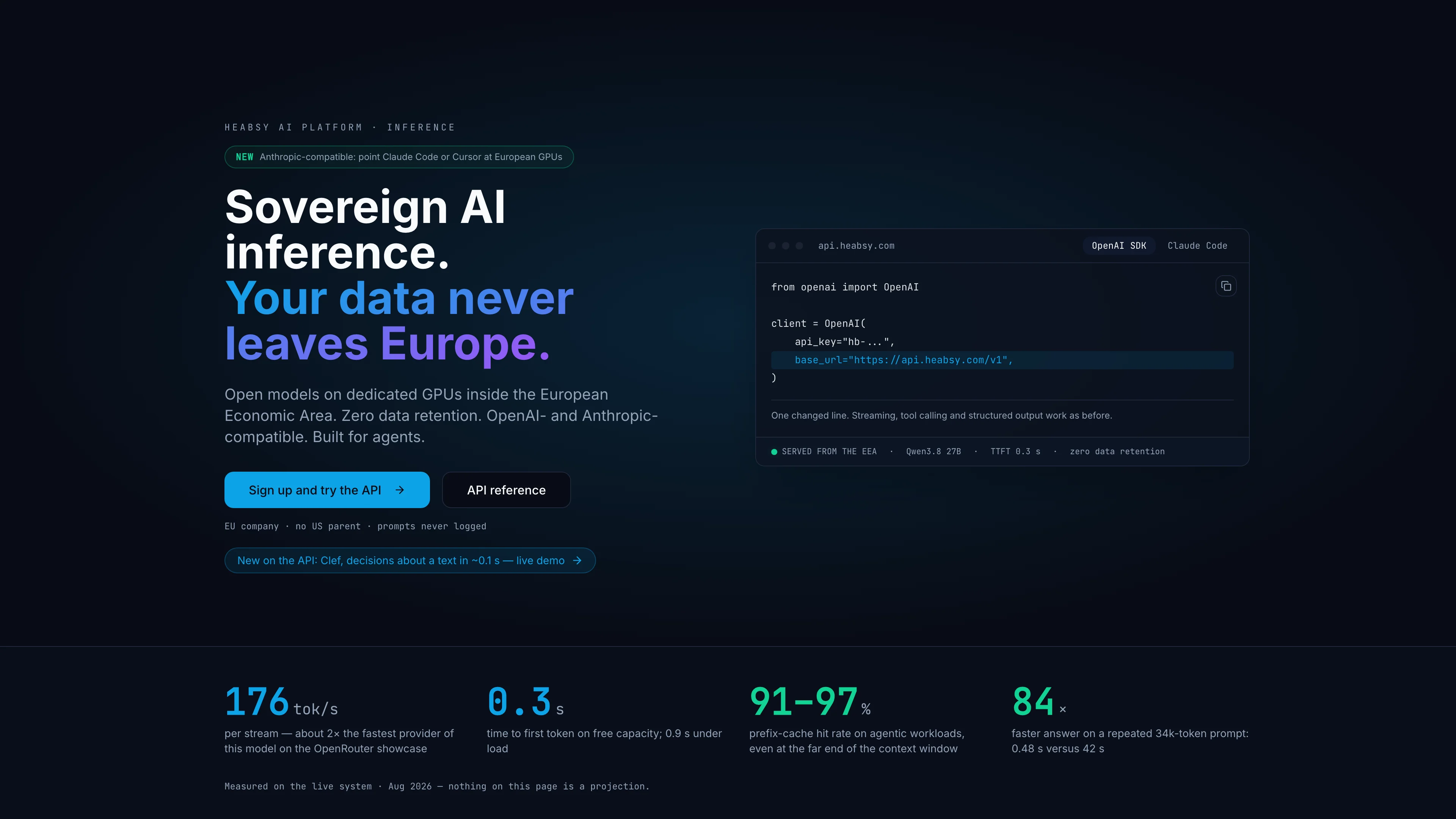
Heabsy is a pay-per-token inference API for open-weight language models that speaks both the OpenAI and the Anthropic API formats. Switching an existing app usually means changing the base URL to Heabsy's endpoint, and the Anthropic-compatible endpoint lets coding tools such as Claude Code run against open models instead.
The catalogue is split in two and labelled model by model. A small set of models, led by Qwen3.8 27B, runs on GPUs provisioned in data centres inside the European Economic Area, where prompts and completions are processed in memory only and never logged or used for training. Most of the catalogue is routed: Heabsy buys capacity from global providers through OpenRouter and bills it on one invoice, and those requests may be processed outside the EEA. Billing is per token, with no subscription and no minimum spend.
Key benefits:
- Drop-in OpenAI compatibility for chat completions, streaming, tool calling and structured output
- Anthropic-compatible endpoint for tools built on the Claude API format
- EEA-only processing for the models labelled EEA-only in the catalogue
- Zero data retention on those models, with only token counts and metadata kept for billing
- Clear labels showing which models are processed inside or outside the EEA
- One European invoice and DPA covering every model in the catalogue
Heabsy is a brand of FEYA, s.r.o., a limited liability company registered in Bratislava, Slovakia, under Slovak law. Only the models marked EEA-only stay in Europe: routed models are fulfilled through OpenRouter (US) and their upstream providers, and the privacy policy also lists Cloudflare and optional Google sign-in as global sub-processors under the EU-US Data Privacy Framework or standard contractual clauses.
Ideal for developers who want an OpenAI-style API and can pin sensitive workloads to the EEA-only models.
-
Sovereign enterprise large language models with explainable answers, multilingual support, and on-premise or EU data-centre deployment for regulated organizations.
Aleph Alpha is a German enterprise AI company from Heidelberg building sovereign large language models for governments and regulated industries that cannot send their data to US clouds. Its PhariaAI platform is designed to be deployed inside an organization's own infrastructure, with a focus on transparency and traceability rather than a black-box chatbot.
Where consumer AI hides its reasoning, Aleph Alpha emphasizes explainability, letting operators trace which sources informed an answer, a requirement for public-sector and compliance use. The stack runs on-premise or in sovereign European data centers, supports multiple European languages natively, and is built to satisfy the EU AI Act.
Key features:
- Sovereign LLMs deployable on-premise or in EU data centers
- Explainability tools that trace answers back to their sources
- Multilingual strength across European languages
- On-premise deployment keeping sensitive data inside your walls
- Enterprise integration for retrieval over private document sets
- EU AI Act alignment for regulated and public-sector use
Aleph Alpha is developed by Aleph Alpha GmbH in Heidelberg, Germany, backed by major European investors and positioned as the continent's answer to OpenAI and Anthropic for sovereignty-critical deployments. Its customers are governments, defense, and enterprises that treat data residency as non-negotiable.
Ideal for European public bodies and regulated enterprises that need generative AI they can run and audit on their own infrastructure.
-
Austrian AI startup providing infrastructure for running large language models, aimed at teams looking for European options for their AI workloads.
-
Dutch AI gateway routing your requests to European-hosted language models through a single API, keeping prompts and data under EU jurisdiction.


