8 Best European Google Photos Alternatives in 2026
The best European alternative to Google Photos in 2026 is Piwigo, based in France. All 8 options below are European-owned, GDPR-native and ranked by feature parity and relevance.
By the EU Alternatives team Last updated
Our top pick this year is Piwigo, but every option on this list is European-owned, GDPR-native, and production-ready. Worth a closer look: Ohhi, PhotoPrism, MemoFamille, Proton Drive.
Google Photos alternatives are mainly Cloud & Hosting. Browse that category for a wider shortlist beyond this list.
Top European Google Photos alternatives compared
| # | Alternative | Country | Open source | Free tier | Compare |
|---|---|---|---|---|---|
| 1 | Piwigo | France | Yes | Yes | vs Google Photos → |
| 2 | Ohhi | Netherlands | No | Yes | vs Google Photos → |
| 3 | PhotoPrism | Germany | Yes | Yes | vs Google Photos → |
| 4 | MemoFamille | France | No | No | — |
| 5 | Proton Drive | Switzerland | No | Yes | — |
-
Open source photo management with album hierarchies, granular permissions, 200+ plugins, and hosting that stays in Europe, self-hosted or managed cloud.

Piwigo is a French open source photo management platform that has been organizing photo collections since 2002, from family archives to institutional libraries with hundreds of thousands of images. Album hierarchies, batch management, and granular permissions per user and group make it equally at home for a family and a museum.
Run it two ways: self-host the GPL code for free, or use the managed cloud that Piwigo states is developed and hosted in Europe. Beyond photos, it handles videos, audio, and documents, effectively serving as a lightweight digital asset manager, and an ecosystem of 200+ plugins and themes adapts it to almost any workflow.
Key features:
- Album hierarchies that stay navigable at hundreds of thousands of photos
- Granular permissions controlling exactly who sees which albums
- Batch management for tagging, moving, and editing at scale
- 200+ plugins and themes for customization without forking
- Videos, audio, and documents supported alongside photos
- Web-based with mobile apps for browsing and uploads
- Free self-hosted version under GPL, or managed European cloud
Piwigo is operated by PigoLabs SAS, registered in the Nantes area, France, with cloud hosting in Europe and clients including BNP Paribas and Thomas Cook. Two decades of continuous development make it one of the most battle-tested Google Photos alternatives in Europe.
Ideal for families, associations, and organizations that want their photo library on European soil, self-hosted or managed.
-
Share photos and videos with an invited circle only: chronological timeline, shared albums with roles, no ads, no algorithm, EU servers.
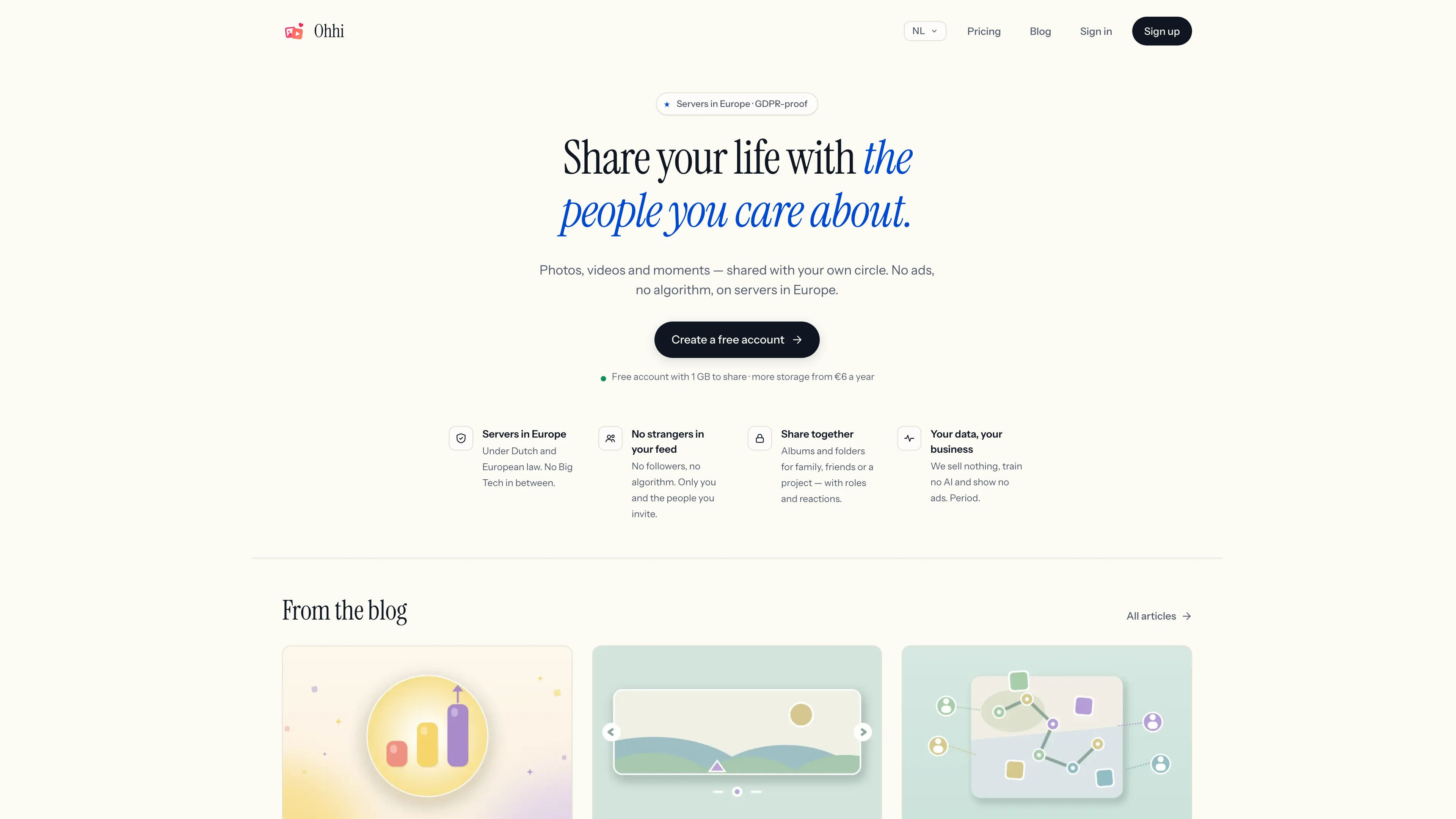
Ohhi is a private photo and video network for family and friends, where only the people you invite can see what you share. There are no followers, no public profiles and no recommendation algorithm: the timeline runs in order and shows your own circle, nothing else. Viewing and reacting stays free, so relatives can join without paying anything.
Photos go into folders and albums with per-person roles, from view-only through contributing to managing, and everyone comments and reacts in place. Trip folders lay a holiday out day by day and on a map, and optional face grouping runs on Ohhi's own servers rather than an external AI API.
Key benefits:
- Invite-only circles so no follower, stranger or ranking algorithm reaches your photos
- Albums with roles covering view-only, contributing and managing access per person
- Free to view and react so family can join without taking a subscription
- One plan for six accounts shared across parents, children and grandparents
- Opt-in face grouping processed in Ohhi's own environment, never an external AI API
- Trips on a map built from your own photo coordinates, place names resolved in house
- Native iOS and Android apps uploading straight from the phone, plus a browser library
Ohhi is run from Nijmegen in the Netherlands by Geraedts Holding B.V., under Dutch law and the GDPR. Photos and videos are stored with Hetzner in Germany and Finland, delivered through Bunny CDN in Slovenia and billed through Mollie in Amsterdam. The company commits in writing to no ads, no tracking cookies, no third-party analytics and no AI training on user content.
Paid plans run from €6 to €149 a year. Ohhi deliberately does not rebuild public pages, groups or Marketplace: it replaces the part of Facebook and Instagram most people actually use.
-
Self-hosted photo library with AI search, face recognition, RAW support, and world maps, keeping every picture on hardware you control.

PhotoPrism is a German self-hosted photo app that brings Google Photos intelligence to hardware you own: AI-powered search classifies your pictures automatically, recognizes faces, and finds "beach sunset 2019" without a single manual tag. Nearly 40,000 GitHub stars make it one of the most popular self-hosted projects in the world.
The engine indexes RAW files and all common photo and video formats, plays Live Photos, and plots everything on high-resolution world maps. It runs via Docker on a home server, NAS, or Raspberry Pi, and the AGPL Community Edition is free forever, with paid tiers adding multi-user roles for teams.
Key features:
- AI search and classification finds photos by content, no manual tagging
- Face recognition groups people across your entire library
- RAW support plus every common photo and video format
- World maps showing where every picture was taken
- Runs anywhere via Docker, NAS, Raspberry Pi, or cloud VPS
- Free Community Edition under AGPL with full data ownership
- No cloud dependency, your originals never leave your server
PhotoPrism is developed by PhotoPrism UG in Berlin, Germany, self-funded and independent, with a dedicated GDPR documentation page. Since you host it yourself, sovereignty is structural: no provider ever holds your memories.
Ideal for self-hosters leaving Google Photos who want the smart features without the surveillance.
-
Share family photos and videos in one private album joined by a family code, simple for grandparents, ad-free, hosted in France.
MemoFamille is a private photo and video album for one family, built so that grandparents can use it without help. Parents, grandparents, uncles and aunts join the same space with a family code, then share and comment on memories that would otherwise get lost in group chats. The app and website are in French only.
One subscription covers the whole family, with unlimited members, unlimited photos and videos of up to ten minutes. The apps run on iPhone and Android, and relatives who prefer a computer open the album in a web browser without installing anything. Notifications tell everyone when something new arrives, and a Méli-Mélo feed resurfaces older memories at random.
Key benefits:
- Family code access so only invited relatives see the album
- Designed for older users with a simple open, look and comment flow
- Unlimited members and photos on a single family subscription
- Videos up to ten minutes in the same feed as the photos
- Events and reactions to gather a birthday or holiday and talk about it in place
- No advertising in the album, as a stated commitment
- Free data export so the family keeps its archive if it leaves
MemoFamille is published by Yann Bronner, a sole trader registered in Mulhouse, France, since 2024. Photos, videos, the database and account data are hosted in France by OVHcloud, and audience measurement uses Umami on those same servers plus PostHog in the EU. Some supporting services are American: RevenueCat manages in-app subscriptions, Expo delivers push notifications, Sentry collects error reports and GrowthBook runs site tests, while Firebase Analytics and Google Ads measurement run only with consent given in the app.
After a 30-day trial with no card required, it costs €5.99 a month, or €59.88 a year (€4.99 a month).
-
Securely store, back up, and share your files with end-to-end encrypted cloud storage from Switzerland. Access your data anywhere, with privacy as a priority.

Proton Drive is the end-to-end encrypted cloud storage service from Proton, the Swiss privacy company behind ProtonMail. Every file is encrypted on your device before upload (not even Proton can access your data), and shared links can be password-protected with expiry dates. It includes Proton Docs and Sheets for encrypted real-time document and spreadsheet collaboration.
Available on web, Windows, macOS, iOS, and Android, Proton Drive syncs files automatically via a desktop folder. 5 GB of free storage is included with every Proton account, with upgrades that bundle Mail, Calendar, VPN, and Pass. An open-source codebase allows independent cryptographic verification by any researcher.
Key benefits:
- Client-side E2E encryption that encrypts files before they leave your device
- 5 GB free storage with every Proton account, no credit card required
- Password-protected sharing with configurable expiry on shared links
- Automatic mobile photo backups with encrypted collaborative album sharing
- Proton Docs and Sheets for encrypted real-time collaborative document editing
- Desktop sync folder on Windows and macOS for automatic file synchronisation
- Open-source code for independent cryptographic audit by the community
Proton AG is headquartered in Geneva, Switzerland, which operates under some of the world's strictest privacy laws, outside U.S. and UK jurisdiction. The service is GDPR-compliant, holds ISO 27001 certification, and is audited by independent security researchers. Switzerland's constitutional privacy protections and absence of mandatory data retention laws provide a legal framework stronger than most EU alternatives.
Part of the Proton ecosystem trusted by over 100 million users worldwide, from journalists and activists to enterprises requiring sovereign data storage.
-
Austrian end-to-end encrypted photo and video cloud, hosted in Germany

Zeitkapsl is an Austrian end-to-end encrypted photo and video cloud, essentially a privacy-first Google Photos alternative. Built by an Austrian team, it stores encrypted data across two data centers in Germany and pitches itself as "verifiable real privacy" rather than privacy as marketing.
Photos and videos are encrypted with a user-held key before upload, so Zeitkapsl operators cannot read them. The service automatically backs up originals in full quality, performs face recognition on-device (not in the cloud), syncs across multiple devices, and supports secure album sharing via link or QR code without forcing recipients to create accounts. The applications are open-source and offline-capable.
Six tiers range from €2/month for 50 GB up to €26/month for 2 TB, with roughly 17% off for annual billing. Plans support storage sharing across multiple household members. There's no free tier by design. Revenue comes exclusively from subscriptions, so there's no advertising, data mining, or AI training on user content. Upon cancellation data is retained for 14 days before deletion, fully GDPR-compliant. It's aimed at Google Photos / iCloud users who want Apple-level convenience without surrendering their photo library to a US hyperscaler.
-
French collaborative platform based on Nextcloud open-source. Document editing, chat, video calls, and file sharing hosted on sovereign cloud infrastructure.
Leviia Next is a French collaborative workspace built on Nextcloud combining file sync and share, calendars, contacts, video meetings, chat, office documents and tasks in a single sovereign platform. Operated by Leviia, a French cloud provider headquartered in Le Havre, it targets businesses and public-sector organisations that need a Microsoft 365 or Google Workspace replacement hosted entirely in France.
The platform pairs the open-source Nextcloud Hub with Leviia's managed operations, S3-compatible object storage and datacentre infrastructure. Users get familiar web, desktop (Windows, macOS, Linux) and mobile clients, real-time co-editing through Collabora Online, integrated Nextcloud Talk for chat and calls, and client-side encryption options for sensitive folders.
Key benefits:
- File sync and share across Windows, macOS, Linux, iOS and Android clients
- Real-time co-editing of documents, spreadsheets and presentations via Collabora Online
- Nextcloud Talk for chat, audio and video conferencing with screen sharing
- Calendars, contacts and mail with CalDAV, CardDAV and standards-based sync
- End-to-end encrypted folders for sensitive data with client-managed keys
- Managed operations including updates, backups and 24/7 French-speaking support
- Open-source core (AGPLv3) with no vendor lock-in on file formats or data export
Leviia Next is headquartered in Le Havre, France, with data centres located in France under GDPR and French CNIL oversight. ISO 27001 certification, SecNumCloud alignment, a full DPA and contractual exclusion of any non-EU sub-processor are standard on every plan.
Ideal for French and European organisations, including public administrations, healthcare providers and regulated industries, that need a sovereign, Nextcloud-based alternative to Microsoft 365 or Google Workspace hosted entirely under French jurisdiction.
-
Securely store your photos in Europe with private facial recognition and AI search. Back up instantly from iPhone & Android. Your memories, safe and accessible.
PixelUnion offers managed photo and video storage for people who want a European home for their library without maintaining a server. Automatic phone backups, facial recognition, and object search cover familiar Google Photos tasks. The practical distinction is that the service runs the infrastructure, while the interface and mobile workflow are built around Immich.
The platform uses a fork of Immich, with support for its iPhone and Android apps. Photos can be browsed, searched, mapped, and shared, with additional users available for friends or family. Managed hosting removes the installation and upkeep that normally accompany running a photo server, although storage capacity still depends on the chosen plan.
Key features:
- Phone backups copy photos from compatible iPhone and Android apps automatically
- Facial recognition helps find pictures of familiar people within the library
- Object search locates images through recognised subjects rather than filenames alone
- Photo sharing lets users share selected memories with the people they choose
- Map view offers another way to browse photos through their recorded locations
- Immich foundation brings an established photo-management interface to a hosted service
The operator is PixelUnion V.O.F., based in Alkmaar, Netherlands, founded in early 2025. It states that photos are stored in the European Union with EU companies and that servers use renewable energy. The open source Immich foundation is distinct from a claim that every part of the managed service is publicly licensed.
A permanent free plan includes 16 GB. Paid monthly storage starts at EUR 2.95 for 150 GB, with larger plans and annual discounts. It suits a growing personal library, but testing mobile backup and search with a small collection first helps establish whether the workflow fits.


How to actually make the switch
A personal de-Googling guide ordered by pain: search and translate in minutes, maps and photos in an evening, mail over a month, and the honest cost of each swap.
Every Google service in a business stack has a European replacement. The practical migration order runs from search and analytics to files and email.