4 Best European GitLab Alternatives in 2026
The best European alternative to GitLab in 2026 is Forgejo, based in Germany. All 4 options below are European-owned, GDPR-native and ranked by feature parity and relevance.
By the EU Alternatives team Last updated
Our top pick this year is Forgejo, but every option on this list is European-owned, GDPR-native, and production-ready. Worth a closer look: Codeberg, CodeFloe, SourceHut.
GitLab alternatives are mainly Developer Tools. Browse that category for a wider shortlist beyond this list.
Top European GitLab alternatives compared
| # | Alternative | Country | Open source | Free tier | Compare |
|---|---|---|---|---|---|
| 1 | Forgejo | Germany | Yes | Yes | vs GitLab → |
| 2 | Codeberg | Germany | Yes | Yes | vs GitLab → |
| 3 | CodeFloe | Switzerland | Yes | Yes | vs GitLab → |
| 4 | SourceHut | Netherlands | Yes | No | vs GitLab → |
-
Self-host Git repositories, issue tracking, CI/CD, and package registries on a lightweight open-source forge governed by a non-profit, with no corporate lock-in.
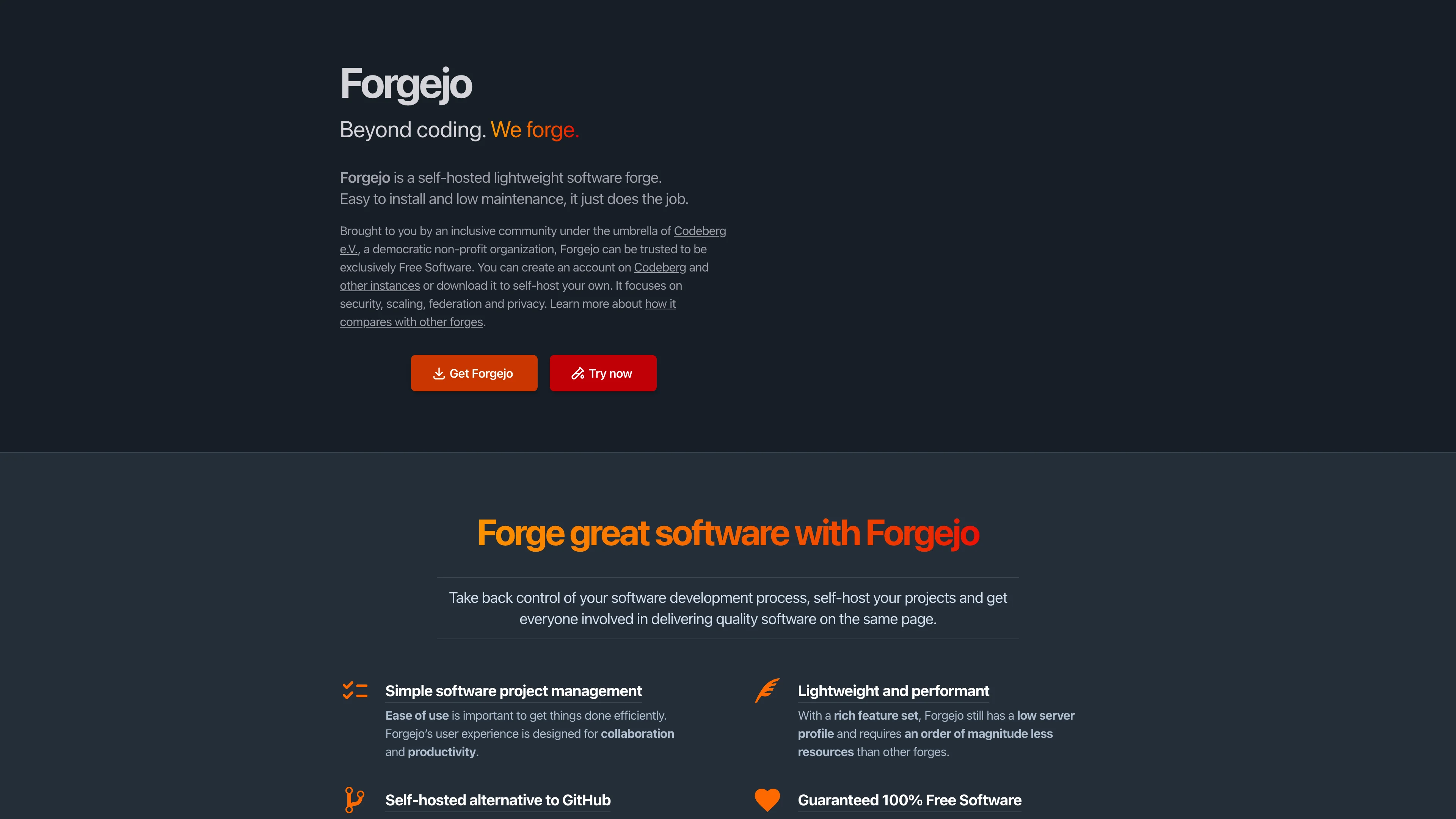
Forgejo is an open-source self-hosted software forge for Git repositories, issue tracking, pull requests, CI/CD pipelines, and package registries, governed by Codeberg e.V., a German democratic non-profit. Forked from Gitea in 2022 over governance concerns, it uses an order of magnitude fewer server resources than comparable forges and can run on a Raspberry Pi or minimal VPS.
Installation takes minutes on any Linux server or container host. ActivityPub federation is in active development to enable cross-instance interactions such as following repositories and commenting on issues across independent Forgejo servers. A GitHub-compatible interface and API simplify migration from proprietary platforms without workflow disruption.
Key benefits:
- Full Git hosting covering repositories, branches, tags, and LFS with a familiar web interface
- Issue tracking and PRs with labels, milestones, projects, and code review workflows
- Forgejo Actions for built-in CI/CD compatible with GitHub Actions workflow syntax
- Package registry for Docker, npm, PyPI, Maven, Cargo, and other formats
- ActivityPub federation for cross-instance interactions across the Fediverse
- Minimal resource footprint that runs comfortably on a Raspberry Pi or 1-vCPU VPS
- MIT licensed and governed by Codeberg e.V., a non-profit with no corporate investors
Forgejo is maintained by Codeberg e.V., a democratic non-profit registered in Berlin, Germany, under German law and GDPR. The project uses only Free Software for its own development and is hosted on Codeberg, not GitHub. Self-hosted deployments keep all code, issues, and CI data on infrastructure you control, with no telemetry by default.
The upstream project behind Codeberg, Europe's largest community-run Git platform, and the default forge for teams requiring full infrastructure ownership.
-
Community-driven Git hosting platform for free and open source projects. Non-profit organization based in Berlin offering secure, privacy-focused development tools.
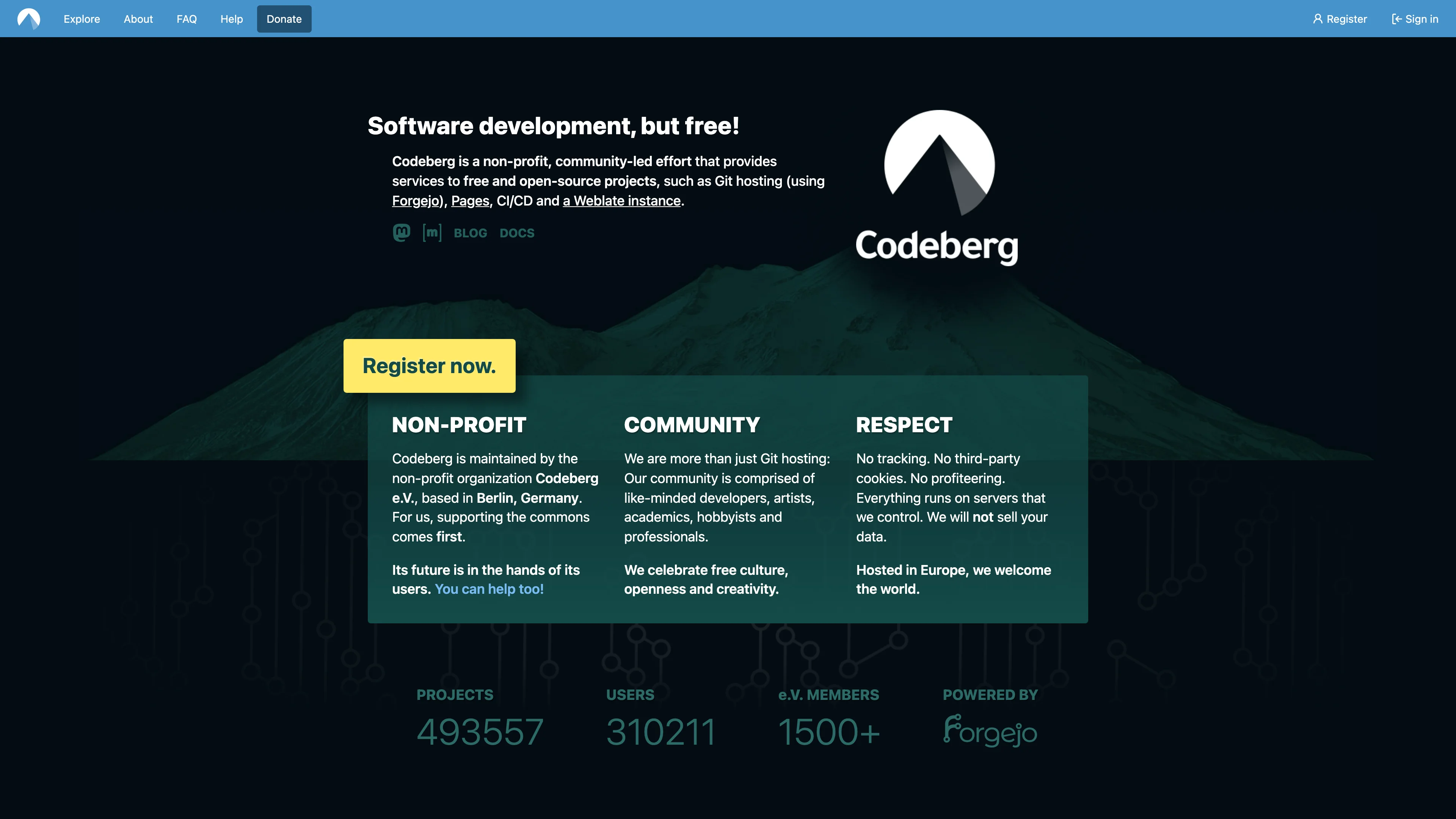
Codeberg is a non-profit Git hosting platform run by Codeberg e.V., a registered German association providing free, community-owned hosting for free and open-source software. Launched in 2019 and based in Berlin, it runs on the Forgejo engine (a Gitea community fork) and is funded entirely by members and donations.
The platform offers public and private repositories, issue tracking, pull requests, a built-in CI service (Codeberg CI, based on Woodpecker), package registries, static site hosting through Codeberg Pages and federated identity through its own account system. No commercial tier exists. All features are free for FOSS projects that align with the charter.
Key benefits:
- Unlimited free repositories for free and open-source projects aligned with the charter
- Forgejo-powered Git hosting with issues, pull requests, wiki and project boards
- Codeberg CI based on Woodpecker, running free for member and FOSS repositories
- Codeberg Pages for static-site hosting from any repository branch
- Package registry for npm, Maven, PyPI, Composer, NuGet, Helm and container images
- Federated activity streams and ongoing ForgeFed / ActivityPub integration work
- Non-profit governance with member voting, public finances and transparent moderation
Codeberg is operated by Codeberg e.V., headquartered in Berlin, Germany, and hosts all repositories on servers in the European Union under GDPR and German association law. The non-profit is financed by membership fees and donations, with no advertising, tracking or AI training on user code.
Trusted by thousands of maintainers, including F-Droid, LibreOffice contributors and Framasoft projects, Codeberg is the reference choice for developers who want non-commercial, EU-sovereign Git hosting.
-
Forgejo-based Git hosting with free private repositories, built-in CI on amd64 and arm64 runners, package registries and preview environments, no paywalled features.
CodeFloe is a public Git hosting service built on Forgejo that gives every account the full feature set for free. Private repositories, CI, package registries and hosted pages are all included, and the project's promise is simple: no feature sits behind a paywall, only extra resources ever will.
Under the hood it runs a lightly patched Forgejo fork with Crow CI for pipelines, offering shared amd64 and arm64 runners with up to 4 CPUs and 7 GB of memory per job. Everything that keeps the platform running, from Ansible playbooks and OpenTofu modules to Kubernetes manifests and monitoring configs, is published in the open so anyone can read how it is operated.
Key benefits:
- Unlimited repositories, public and private, with 5 GB of Git storage per account
- Built-in CI/CD on shared runners without a separate sign-up or approval queue
- Package and container registries with their own 5 GB quota
- Preview environments spun up for pull requests
- Hosted pages for static sites straight from a repository
- One-click migration from GitHub, GitLab and Bitbucket, plus a batch migration CLI
- Readable infrastructure with every playbook, module and pipeline public
CodeFloe is operated by devXY GmbH, registered in Baar, canton of Zug, Switzerland, and runs on Hetzner infrastructure in Germany under German data protection law and the GDPR. It follows a minimum-collection policy, with no user tracking and server logs deleted within seven days. The service launched in July 2025 and is currently funded by its founder and community donations.
A good fit for developers and small teams who want Codeberg-style EU hosting but also need private and commercial projects to be first-class citizens.
-
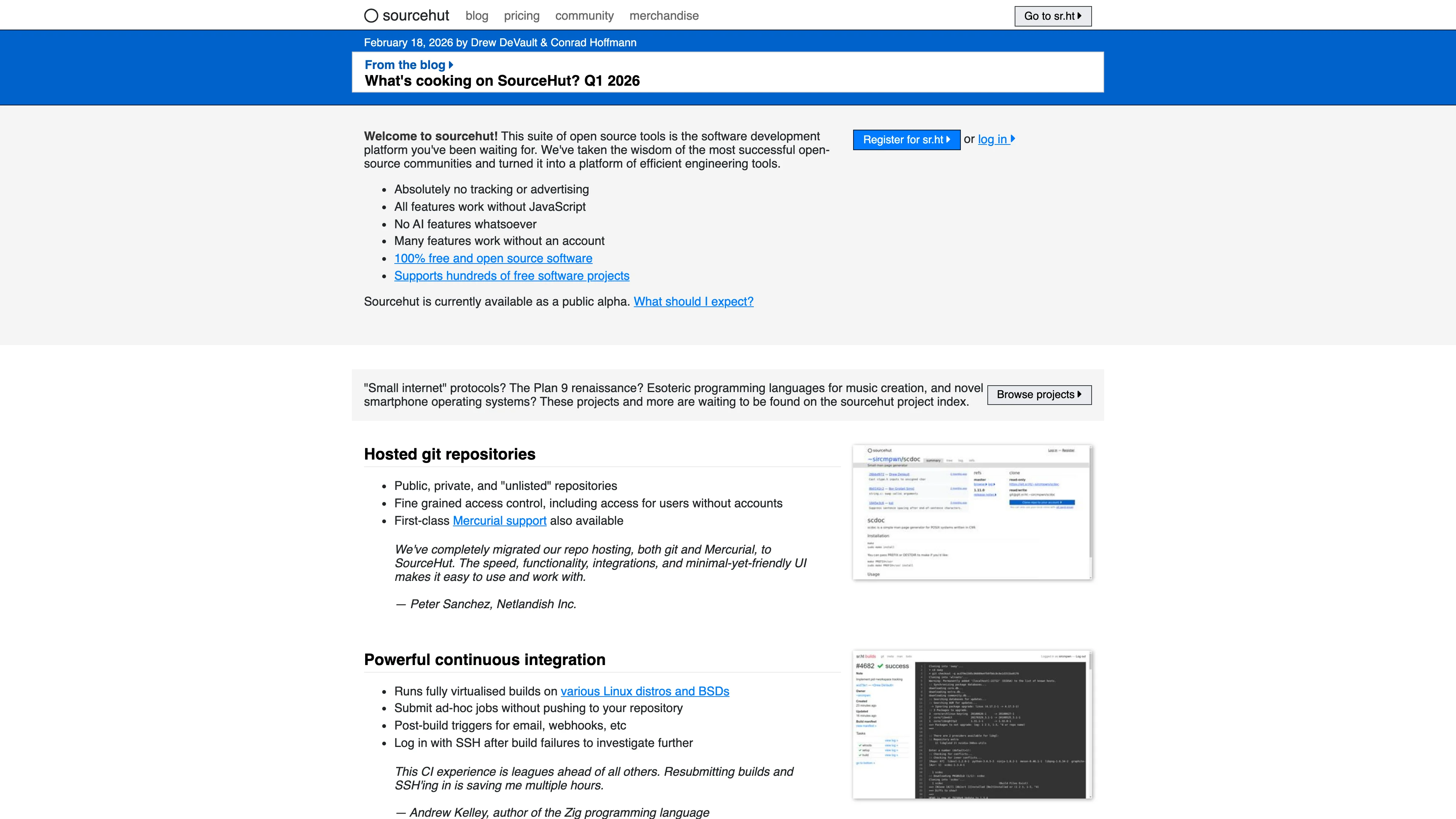
Minimalist open source forge: git and mercurial hosting, mailing lists, CI builds and ticket tracking with no tracking scripts, funded by user subscriptions instead of investors.


