4 Best European Facebook Alternatives in 2026
The best European alternative to Facebook in 2026 is Ohhi, based in Netherlands. All 4 options below are European-owned, GDPR-native and ranked by feature parity and relevance.
By the EU Alternatives team Last updated
Our top pick this year is Ohhi, but every option on this list is European-owned, GDPR-native, and production-ready. Worth a closer look: Mastodon, Hoplr, BeReal.
Facebook alternatives are mainly Content & Media. Browse that category for a wider shortlist beyond this list.
Top European Facebook alternatives compared
| # | Alternative | Country | Open source | Free tier | Compare |
|---|---|---|---|---|---|
| 1 | Ohhi | Netherlands | No | Yes | vs Facebook → |
| 2 | Mastodon | Germany | Yes | Yes | vs Facebook → |
| 3 | Hoplr | Belgium | No | Yes | vs Facebook → |
| 4 | BeReal | France | No | Yes | — |
-
Share photos and videos with an invited circle only: chronological timeline, shared albums with roles, no ads, no algorithm, EU servers.
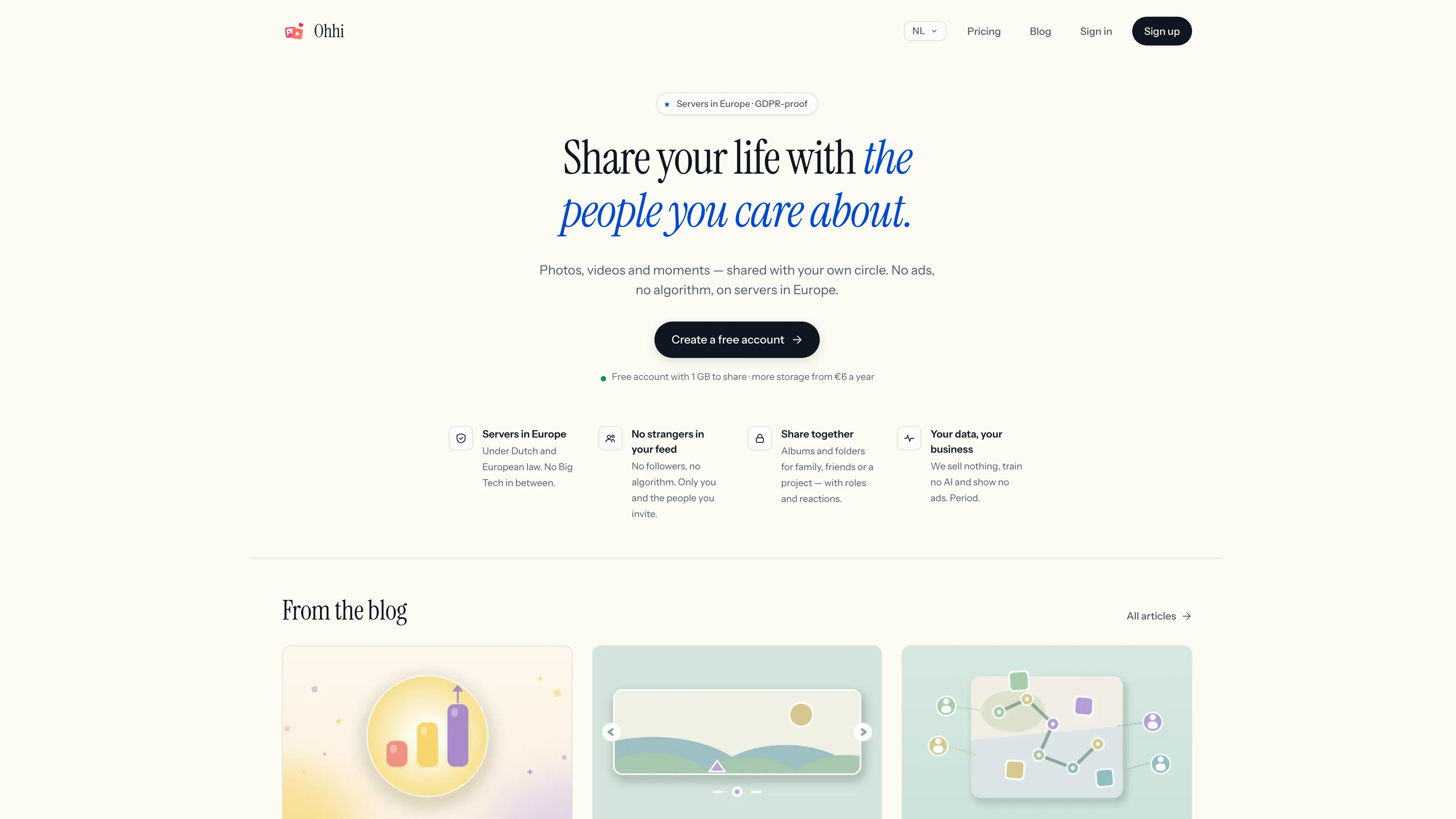
Ohhi is a private photo and video network for family and friends, where only the people you invite can see what you share. There are no followers, no public profiles and no recommendation algorithm: the timeline runs in order and shows your own circle, nothing else. Viewing and reacting stays free, so relatives can join without paying anything.
Photos go into folders and albums with per-person roles, from view-only through contributing to managing, and everyone comments and reacts in place. Trip folders lay a holiday out day by day and on a map, and optional face grouping runs on Ohhi's own servers rather than an external AI API.
Key benefits:
- Invite-only circles so no follower, stranger or ranking algorithm reaches your photos
- Albums with roles covering view-only, contributing and managing access per person
- Free to view and react so family can join without taking a subscription
- One plan for six accounts shared across parents, children and grandparents
- Opt-in face grouping processed in Ohhi's own environment, never an external AI API
- Trips on a map built from your own photo coordinates, place names resolved in house
- Native iOS and Android apps uploading straight from the phone, plus a browser library
Ohhi is run from Nijmegen in the Netherlands by Geraedts Holding B.V., under Dutch law and the GDPR. Photos and videos are stored with Hetzner in Germany and Finland, delivered through Bunny CDN in Slovenia and billed through Mollie in Amsterdam. The company commits in writing to no ads, no tracking cookies, no third-party analytics and no AI training on user content.
Paid plans run from €6 to €149 a year. Ohhi deliberately does not rebuild public pages, groups or Marketplace: it replaces the part of Facebook and Instagram most people actually use.
-
Decentralised open-source microblogging on the ActivityPub standard. No ads, no algorithm, no single point of control, federated across thousands of community-run servers.
Mastodon is a German open-source microblogging platform built on the ActivityPub federation protocol, the W3C standard that enables independent servers to communicate freely. Instead of a single company controlling everything, thousands of independent Mastodon instances connect into a global network where users on one server can follow, reply to, and interact with users on any other.
Each instance sets its own moderation rules, community focus, and data policies. Mastodon gGmbH, the non-profit behind the flagship mastodon.social server, develops the open-source software freely available for any individual or organisation to run. Posts, follows, and interactions federate across instances and also reach users on Pixelfed, PeerTube, Misskey, and other ActivityPub-compatible platforms.
Key benefits:
- Decentralised federation with no single point of control, censorship, or failure
- ActivityPub standard for interoperability across the entire Fediverse ecosystem
- Chronological feed without an engagement-optimising algorithm by default
- No ads, no tracking, no data monetisation on non-commercial instances
- Per-instance moderation that lets each community enforce its own rules independently
- Open-source (AGPL) so anyone can self-host an instance with full administrative control
- Rich media posts with images, video, audio, polls, and content warnings up to 500 characters
Mastodon is developed by Mastodon gGmbH, a non-profit based in Berlin, Germany, operating under German law and GDPR. Self-hosted instances can run in any EU jurisdiction, keeping user data entirely within European legal frameworks and free from U.S. platform control.
Founded by Eugen Rochko in 2016, Mastodon hosts millions of users across thousands of independent instances, making it the largest federated alternative to centralised social networks.
-
Private social network for your street: closed neighbourhood groups, lending and help requests, local authority notices, with no third-party advertising.
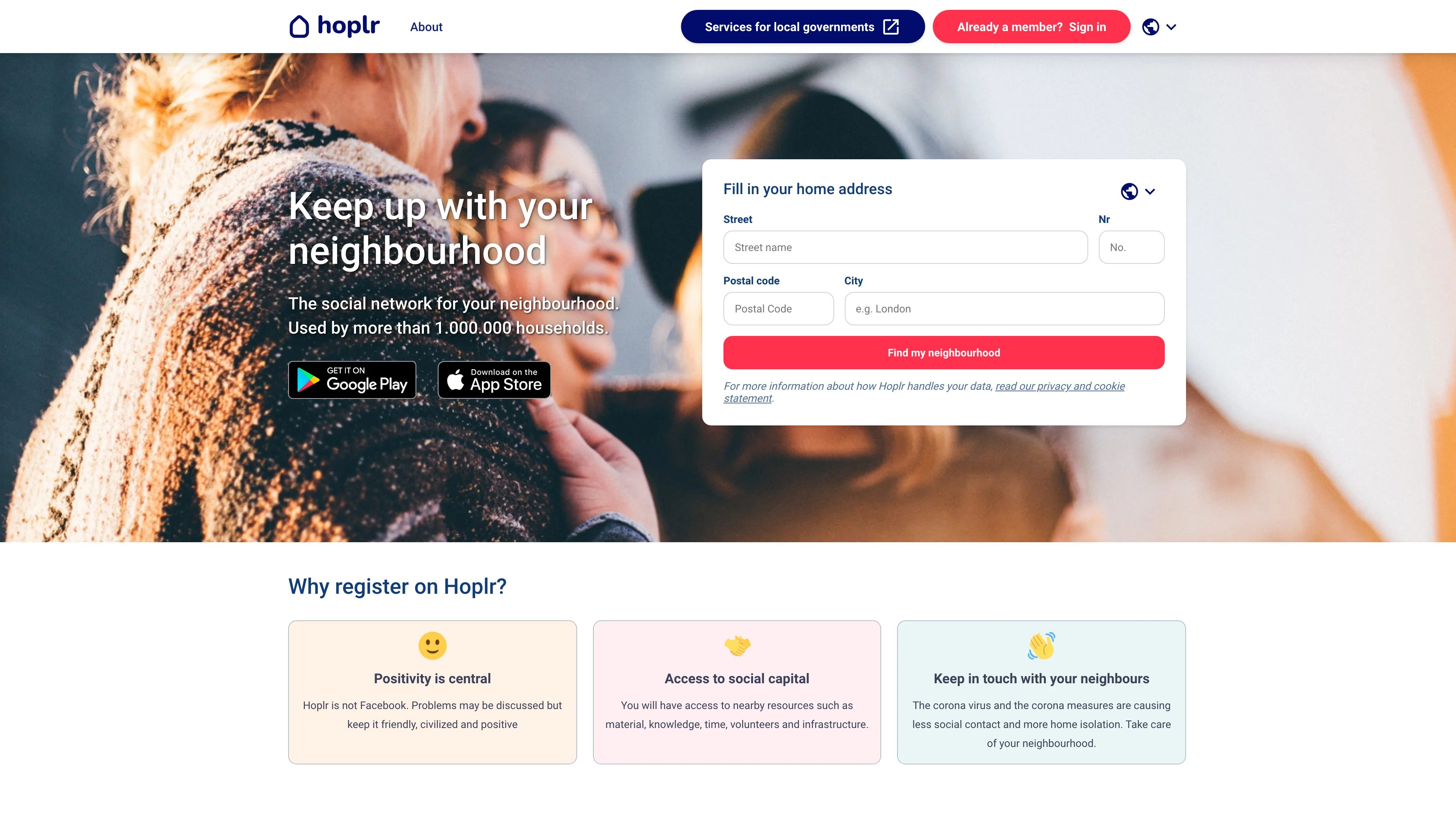
Hoplr is a closed social network for your own street, where membership is tied to a drawn neighbourhood boundary and only residents of that area get in. Neighbours flag roadworks and lost cats, lend out tools, ask for help with a chore, a lift or babysitting, and organise the street party. It is free for residents and carries no third-party advertising.
Local authorities, housing associations and utilities license a dashboard on top of the same network, and that is what pays for it. They can reach one specific neighbourhood with a planned-works notice or a participation survey instead of buying reach on an ad platform. Residents use the web app or the iOS and Android apps.
Key benefits:
- Residents only with membership bound to a mapped neighbourhood boundary
- No third-party advertising on the platform, stated in the terms of use
- Free for residents because the revenue comes from public-sector licences
- Lending and help requests for tools, chores, lifts, babysitting and care
- Local authority notices delivered to the neighbourhoods they actually affect
- iOS, Android and web so a whole street can join on whatever devices people own
Hoplr NV is registered in Lokeren, Belgium under company number BE 0564.835.057, and its terms run under Belgian law with the courts of Antwerp as venue. The company states it does not sell or disclose resident data to third parties without explicit consent, and it holds a Privacy Verified certificate issued by ICTRecht.
Running since 2014 and used by more than a million households across Belgium and the Netherlands, Hoplr suits municipalities and residents who want the neighbourhood group function of Facebook without the platform built around it.


